 Aurafinance
 Staking, Voting, and Wind-Down
Aurafinance is a protocol built on Balancer that pooled voting power to boost liquidity rewards and support token staking. It’s now winding down. Aura’s staking pools now allow withdrawals only. AURA holders can redeem for treasury assets and receive rAURA for a later claim. auraBAL follows a separate redemption path tied to previously locked pool-token backing. Stage 1 opened on 13 May 2026, with later distributions scheduled for 10 May 2027.
Bottom line: AURA redemption creates a later rAURA claim, while auraBAL redemption concerns a separate allocation of the previously locked pool-token backing.
Withdrawals during the protocol sunset
Pool, vault, and locker positions remain withdrawable during the sunset, while Aura’s staking pools operate in withdrawal-only mode. An existing staking position therefore has a withdrawal path before the later token-redemption date. The wind-down treats these withdrawals separately from the treasury and backing distributions. Each action concerns a different holding, even when the same wallet owns several of them.
Withdrawing from pool staking concerns the deposited pool position. A Balancer Pool Token continues to represent that pool’s liquidity after it leaves staking. Exchanging BPT for component assets involves the Balancer pool itself. Likewise, withdrawing locked AURA concerns the locker balance; redeeming AURA concerns the treasury distribution.
Balancer liquidity and pooled voting power
Balancer Pool Tokens, or BPTs, represented the liquidity that depositors supplied to a Balancer pool and formed the input to pool staking.
The earlier staking model combined trading-fee exposure with token incentives. Balancer gauges distributed BAL rewards to eligible staked liquidity. Their reward boost depended on veBAL, Balancer’s vote-escrowed voting position. The protocol pooled that position, letting its deposited liquidity benefit from aggregated voting power.
A depositor’s BPT represented a pool position, while BAL and additional AURA rewards came from the incentive layer.
Projects could also sponsor voting incentives to attract allocations toward their pools. This marketplace connected pool-level liquidity needs with holders who directed the protocol’s voting power. It was another use of the aggregated veBAL position, alongside boosting rewards for deposited liquidity.
auraBAL backing and reward paths
auraBAL represented the pool-token position that the protocol locked into Balancer’s VotingEscrow, creating a transferable token around otherwise locked backing.
The locked pool-token backing
The protocol locked 80/20 BAL/WETH BPT in Balancer’s VotingEscrow to back auraBAL. WETH means wrapped Ether. The backing was therefore a liquidity position involving BAL and WETH. The wrapper made auraBAL transferable while the underlying lock supplied voting power to the protocol.
The original minting path was irreversible. Liquidity pools provided a way to trade auraBAL while its backing stayed locked. A market sale exchanged the token at the available pool price. The wind-down redemption allocates the backing after the lock unwinds.
Staking and liquidity rewards
Historically, holders could stake auraBAL to receive Balancer fee rewards, a share of the protocol’s BAL revenue, and AURA incentives. Another path supplied liquidity to the auraBAL/BPT pool, with its pool tokens then eligible for Aura staking rewards. Direct staking and providing trading liquidity were distinct positions. Neither holding was the same as vote-locked AURA.
AURA governance and vote locking
AURA was the protocol’s governance and incentive token, and vote locking gave holders influence over protocol decisions and Balancer gauge allocations. Locked positions used the vlAURA designation. This differed from auraBAL staking, which participated in rewards associated with locked Balancer backing. During the original operating model, governance participants directed pooled voting power without personally managing the protocol’s entire veBAL position. The sunset now treats locker withdrawal and token redemption as separate actions.
Vault shares and compounded rewards
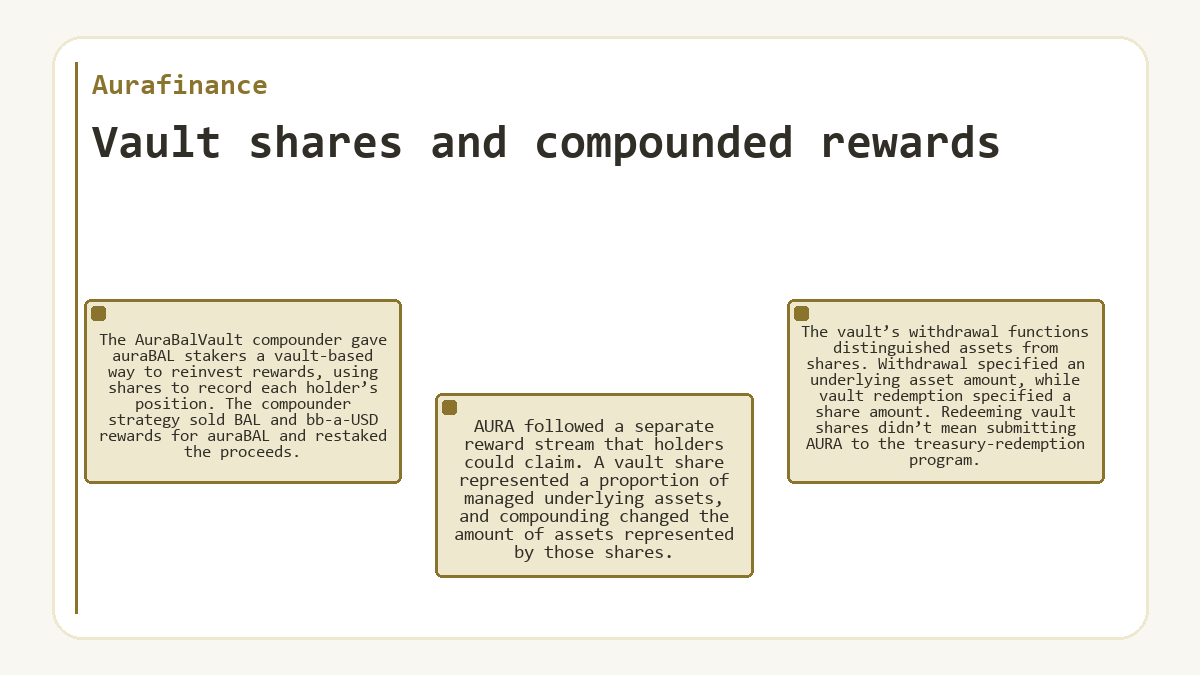
The AuraBalVault compounder gave auraBAL stakers a vault-based way to reinvest rewards, using shares to record each holder’s position.
The compounder strategy sold BAL and bb-a-USD rewards for auraBAL and restaked the proceeds. AURA followed a separate reward stream that holders could claim. A vault share represented a proportion of managed underlying assets, and compounding changed the amount of assets represented by those shares.
The vault’s withdrawal functions distinguished assets from shares. Withdrawal specified an underlying asset amount, while vault redemption specified a share amount. Redeeming vault shares didn’t mean submitting AURA to the treasury-redemption program.
Which withdrawal or redemption applies to each holding?
A holding’s token type and contract determine whether its relevant path is withdrawing an existing position or redeeming a wind-down entitlement.
| Holding | Withdrawal or distribution | Availability condition |
|---|---|---|
| AURA | Pro-rata treasury assets and rAURA | Stage 1 scheduled to close on 10 May 2027 |
| rAURA | Later treasury and backing allocation | Stage 2 scheduled from 10 May 2027 |
| auraBAL | Released BAL/WETH pool-token backing | Stage 3 scheduled from 10 May 2027 |
| LP staking position | Withdrawal of the pool position | Aura staking pools in withdrawal-only mode |
| Vault position | Withdrawal under the vault’s accounting | Vault withdrawals remain available |
Redemption dates and the division of backing
The redemption schedule separates the first treasury distribution from later claims on unclaimed assets and the previously locked BAL/WETH pool-token backing.
Stage 1 and the initial treasury share
Stage 1 opened on 13 May 2026. AURA redemption distributes a pro-rata share of treasury assets and mints rAURA for the later claim. The first-stage claim window is scheduled to close when Stage 2 begins on 10 May 2027.
Stage 2 and rAURA
Stage 2 is scheduled for 10 May 2027. Its rAURA redemption covers treasury assets left unclaimed from Stage 1, plus 10% of the 80/20 BAL/WETH BPT backing. This percentage allocates pool tokens to the rAURA redemption pool; it isn’t a yield forecast.
Stage 3 and auraBAL
Stage 3 is scheduled for the same date. auraBAL holders have the separate redemption for the remaining 90% of that backing. The 10% and 90% allocations concern the same pool-token position. Both groups receive allocations of BPT, which represents the BAL/WETH pool position.
Fees and the value of distributed assets
Historical performance fees applied to BAL revenue from liquidity-provider staking, while network transaction fees covered interactions with the underlying blockchain.
The fee rules distinguished LP-staking BAL revenue from rewards generated by the auraBAL pool and from veBAL administration fees. The historical fee base was reward revenue, so it didn’t describe a percentage deducted from every deposited asset. An old performance-fee figure also doesn’t identify the cost of every sunset redemption.
Redemption distributes assets whose market values can change independently of their token counts. A proportional allocation therefore doesn’t establish fixed dollar proceeds. Blockchain transaction costs also vary with network conditions.
Network deployments and exposure to Balancer
Historical deployments extended beyond Ethereum, so a staking position’s network and contract determined which system held its tokens. Deployments included Arbitrum, Optimism, Polygon, Base, Gnosis, and Avalanche alongside Ethereum. Cross-chain components supported messaging and token movement. In the auraBAL sidechain design, the mainnet bridge held auraBAL in the compounder and routed rewards to sidechain staking contracts.
Integration with Balancer exposed deposited positions to the underlying pool contracts as well as the protocol’s staking contracts. A BPT can change value as its underlying assets change value, and contract failures can affect the assets behind a position.
Receiving BPT leaves the holder exposed to the assets and contracts of that Balancer pool.
Your questions, answered
Is every Aura reward contract ERC-4626 compatible?
The AuraBalVault compounder is ERC-4626 compatible, while the auraBAL and vlAURA reward contracts aren’t. ERC-4626 standardizes tokenized vault interfaces, including the relationship between vault shares and underlying assets. An integration that handles the compounder through that interface can’t assume that ordinary auraBAL staking or the AURA locker implements the same functions.
Can the protocol recover a lost wallet private key?
The protocol can’t restore a lost wallet private key or refund assets lost through missing keys. Control of the address remains necessary to authorize interactions with its holdings.
Does the Aurafinance application require JavaScript?
The web application requires JavaScript to render its interface. A browser that disables JavaScript can display an instruction to enable it instead of the application.
Was Aurafinance backed by venture-capital funding?
The protocol’s historical funding model didn’t include venture-capital investment. It was DAO-led, with governance participation forming part of its operating model.
Do historical APR figures determine token-redemption amounts?
Historical APR figures described projected reward rates, so they don’t determine the amounts distributed in a sunset redemption. Those projections relied on reward flows, market conditions, and other assumptions. The wind-down instead allocates treasury assets and released backing to the relevant token holders.
Could administrators upgrade the original Aura smart contracts?
The original Aura smart contracts were immutable, so administrators couldn’t update their code. Administrative permissions still included specified actions, such as changing fees within coded bounds and shutting down new deposits while preserving withdrawals.
How did sidechain BAL reward timing differ from Ethereum?
Historical BAL incentive distribution used different update paths on layer 2 and Ethereum. The earlier layer-2 BAL reward path had a one-week bridge delay, while an Ethereum staking pool could need a harvest before rewards flowed. That timing concerned incentive delivery during the earlier operating model.